- My Library Account
- Collections
Collections
The Library provides access to books, electronic resources, archives, special collections, and more to support your learning and research.
- Research

Research
The Library is committed to supporting your research needs with expert guidance and resources.
- Studying
Studying
The Library has all the resources and supports you need to be successful in your studies at undergraduate and postgraduate level. Whether you're just starting your studies or working on your final project, we're here to help.
- Teaching

Teaching
We are here to help lecturers and academic staff deliver quality teaching and support their students' success.
- About
- Workshops & Events
Performing Arts
Performing Arts
 |
|---|
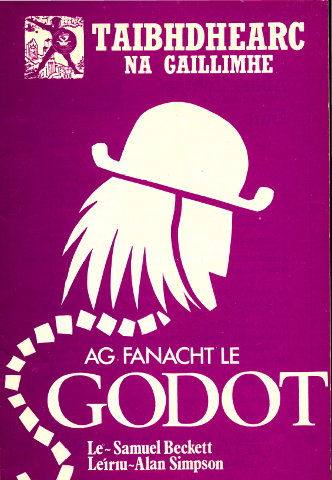
| Programme for "Ag Fanacht le Godot" ("En Attendant Godot") by Samuel Beckett, 1971, Taibhdhearc na Gaillimh, UGA T/T1/4/258. |
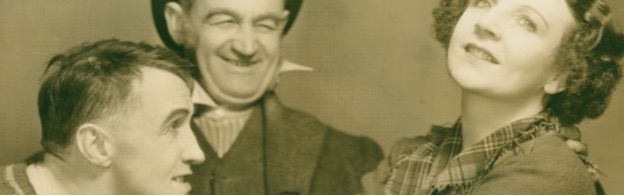
The rich tradition as well as the current practice of theatre and performing arts in Ireland is documented through various collections at University of Galway Library. One of the world’s largest collections of manuscript and digitised archives of drama, theatre, and performance, the library’s holdings include a broad range of theatre and performance collections in both Irish and English language and from across the island of Ireland, and Irish theatre internationally. This comprises a multi-format collection, from manuscript to print to digitised performance records to oral history of contemporary Irish theatre artists.
Theatre in Galway
The history of theatre in the west of Ireland, as well as in Galway city, is reflected within the archive collections. One of the earliest items present is a playbill from Kirwan’s Lane Theatre in the city from 1783. It lists amongst the cast Theobald Wolfetone, a leading member of the United Irishmen, who acted on the historic city stage in a double bill of plays, Douglas and All the World’s a Stage.
Galway city is home to Taibhdhearc na Gaillimhe, Ireland’s national Irish language theatre. Founded in 1928, the theatre developed and showcased the leading work for the stage in the Irish language. The theatre staged and premiered new plays in Irish as well as translations of classic Irish and international plays.
Our university’s archive documents the rich tradition of teaching and producing theatre on campus by our students and staff since the early 20th century. Student and early university annuals and publications include cast photographs and reports from the student drama society. Through the 20th century this tradition continued between classroom and stage. In Summer 1975, a group of recent graduates including Garry Hynes and Marie Mullan, along with Mick Lally and others, formed a new theatre group, Druid Theatre, who would grow over subsequent decades to become Ireland’s leading theatre company and recognised around the world.
 |
|---|
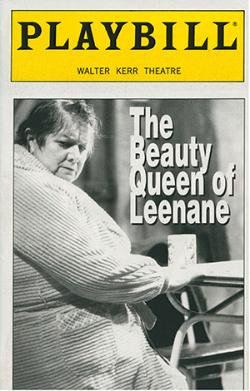
| Programme from U.S. Broadway production by Druid Theatre of The Beauty Queen of Leenane by Martin McDonagh, 1998. Druid Theatre Archive UGA T/T2/1/24/249 |
Druid are synonymous with staging new and daring interpretations of works that define the canon of Irish theatre, as well as nurturing and premiering new Irish plays in Galway that then tour nationally and internationally, from village halls to major world venues. Garry Hynes became the first woman to win the Tony Award for Best Director. The Druid company and ensemble have set levels of excellence in production of well-known Irish and international playwrights, including J.M. Synge, Samuel Beckett, Geraldine Aron, William Shakespeare, Sean O’Casey, Tom Murphy, Sonya Kelly, among many others. The Druid archive contains scripts, photos, posters, digitised show recordings and oral histories with company members, documenting the company, from Galway to Broadway.
Thomas Kilroy was one of Ireland’s leading playwrights and critic. Born in Callan in Co. Kilkenny, Kilroy was long associated with the Abbey Theatre, Dublin, from his first performed play, The O’Neill, produced on the Peacock stage in 1968. The author of over 20 plays for stage and radio, as well as the author of the Booker Prize-nominated novel, The Big Chapel, the Thomas Kilroy archive includes draft play manuscripts, research files, as well as extensive correspondence files to others including his close friend and fellow playwright, Brian Friel.
Digital Theatre Collections
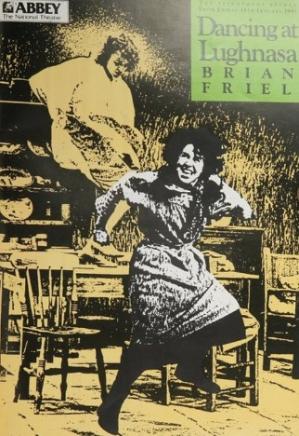
The Abbey Theatre Digital Archive comprises the largest digital archive of a single theatre in the world. At over one million items, the Abbey Theatre digital archive allows clickable access to show recordings, stage designs, audio, scripts, programmes, posters, administration files and more from over 120 years of the Abbey’s history. The Irish national theatre of Ireland, the Abbey, was the first state-subsidised theatre in the English-speaking world from the 1920s.
 |
|---|
| Programme cover from Dancing at Lughnasa by Brian Friel, Abbey Theatre Digital Archive. 1991 |
The Dublin Gate Theatre archive, also digitally available at University of Galway Library, comprises material mainly from the 1970s-present but reflects the theatre’s history dating back to its founding in 1928. The Gate Theatre digital archive includes hundreds of videos, scripts, programmes, posters, and designs, many of them relating to major Irish and international writers associated with the Gate, including Brian Friel, Harold Pinter, Tennessee Williams, Samuel Beckett, among others. Indeed, Friel premiered seven plays at the Gate during the last 20 years of his life.
Also included is a full run of the journal, Motley, founded and edited by Mary Manning and published by the Gate Theatre during the 1930s, offering an important record of criticism and discussion of arts and culture in Ireland and internationally, furthering the Gate’s reputation as a cosmopolitan centre in a European capital city.
The Gate and Abbey Digital Archives are available to consult by readers on site only in the Archives and Special Collections Reading Room.
Women Theatre Makers
Plays made and performed by women theatre makers comprise an important facet of the theatre collections. Siobhán McKenna, born in Belfast, was a student of this university in the 1940s and was part of the Student Drama Society. She began her theatre career acting in Irish at An Taibhdhearc in Galway city, performing in Macbeth in Irish. Later, McKenna performed to audiences at Dublin’s Abbey Theatre and Gate Theatre, and in New York with roles on- and off-Broadway, including an experimental production of Shakespeare’s Hamlet in 1957. A committed activist, McKenna was part of many protests and marches in Northern Ireland and for causes including the Irish Anti-Apartheid Movement.
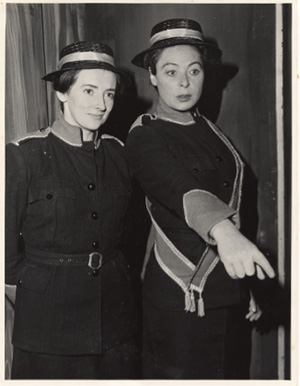 |
| Lelia Doolan (l) with Siobhan McKenna in St. Joan of the Stockyards by Bertolt Brecht, 1961, Gate Theatre Digital Archive. |
Carolyn Swift was co-founder of Dublin’s Pike Theatre in 1953. Her play, The Millstone, which addressed themes of childhood adoption, was the first Pike Theatre Company production in 1951, pre-dating the establishment of the Pike theatre in Dublin city’s Herbert Lane.
A playwright, producer, editor, and critic, Swift worked directly with Brendan Behan and Samuel Beckett at the Pike in the 1950s, where plays by both playwrights were first produced in Ireland. Following the closure of the Pike, Swift worked as producer, writer and editor in RTÉ from the mid-1960s and 1970s, on programmes which included Harbour Hotel, Tolka Row and Wanderley Wagon. Swift also published numerous books for children and was dance critic for The Irish Times for over twenty years.
Mary O’Malley founded the Lyric Players Theatre, an amateur group at her home in Belfast in 1951, along with her husband, Pearse O’Malley, before developing into a professional theatre at a bespoke new building in 1968. O’Malley was a skilled director and producer, in particular the plays of W.B. Yeats. The Lyric Theatre had an important role within Belfast culture, staying open and active throughout the years of the conflict of the Troubles in Northern Ireland. Mary O’Malley was founding editor of Threshold literary journal, first published in 1957, and which was part of the many cultural ventures at the Lyric, including a drama school, craft shop, and art gallery. Over thirty issues of Threshold were published between 1957 and 1990. It remained an important outlet for new poetry and fiction from Northern Ireland, Ireland and internationally. The Lyric Theatre archive includes detailed administrative records from the theatre’s founding, as well as creative records of production from the early 1950s through to the 1990s.
Lelia Doolan is a theatre and film-maker and director and has worked in theatre and television production since the 1950s. She completed a PhD in Anthropology at Queen’s University Belfast during the 1970s and served as Artistic Director of the Abbey Theatre, Dublin, from 1971 to 1973. She was both a member and Chair of the Irish Film Board during the 1980s and 1990s and was a founder of the Galway Film Fleadh and Pálás Cinema.
Genevieve Lyons was a co-founder of the Dublin Globe Theatre Company in 1954. An actress, she starred in numerous Globe Theatre productions at their base in Dun Laoghaire. In 1956 she starred as ‘Sally Bowles’ in the play, I Am a Camera, a work that would later be adapted to become the Broadway and film hit, Cabaret.
Contemporary Irish Theatre
 |
|---|
|
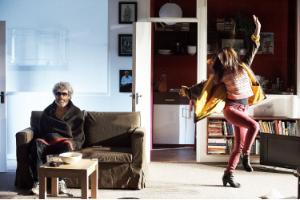
Andrew Bennett and Judith Roddy in Everyone is King Lear in His Own Home by Pan Pan Theatre Company, 2012. Photo by Ros Kavanagh. Pan Pan Theatre Archive |
Contemporary Irish theatre and its development through the 1990s can be seen through a range of archive collections at University of Galway Library. Pan Pan Theatre Company was founded in Dublin by Gavin Quinn and Aedin Cosgrove in 1993. Initially known as Ireland’s first deaf ensemble, the company produced work for and by deaf artists, Pan Pan continued to evolve and become one of Ireland’s most recognised experimental and avant-garde theatre companies. The company has engaged extensively with the works of William Shakespeare and Samuel Beckett as well as European and classic international theatre and is recognised internationally for pushing boundaries of theatrical form and technology. Pan Pan tour productions internationally and collaborate with theatre makers from all over the world, bringing Irish theatre into dialogue with new audiences and cultures.
Link to Pan Pan Theatre Company Digital Exhibition
Link to archive launch press release
The Corn Exchange Theatre Company specialise in producing work in Commedia d’ell’Arte, a highly stylized form of theatrical expression. Founded by director Annie Ryan and playwright Michael West in 1995, the company brought an entirely unique form of embodied performance into Irish theatre, re-interpreting Irish classics as well as a contemporary international repertoire through their unique style. The Corn Exchange archive includes draft scripts and adaptations by Michael West as well as director’s notebooks by Annie Ryan.
Joe Vanek is one of contemporary Irish Theatre’s most celebrated designers. From the late 1970s through to the mid-1980s Vaněk worked at the Tricycle Theatre, the Young Vic and across West End venues in London. Vaněk was Head of Design at the Palace Theatre Watford, from 1980 to May 1984, before moving to Dublin in 1995.
In 1992, Vaněk was nominated for two Tony Awards, (Best Set and Best Costumes) and a Drama Desk Award for Best Set Design for the Broadway production of Friel’s Dancing at Lughnasa. He was also nominated for The Irish Times/Irish Theatre Awards Best Design for The Shape of Things (Gate Theatre, 2002) and The Goat, or Who is Sylvia? (Project Arts Centre, 2005). In 2001, Vaněk won the Irish Times/Irish Theatre Award for Best Costume Design for the Opera Ireland production of The Silver Tassie (Mark Anthony Turnage) and also for The Queen of Spades (Opera Ireland) in 2002.
 |
|---|
|
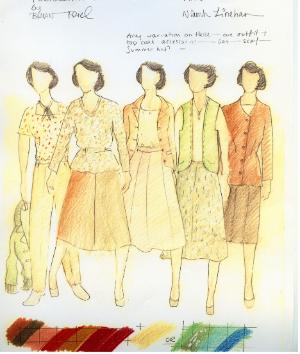
Costume designs by Joe Vaněk for Performances by Brian Friel, 2003. Joe Vaněk Archive, T26/22/1/5 |
Vaněk’s work is closely associated with the plays of Brien Friel, including the premiere productions of Tony-Award winning Dancing at Lughansa, Wonderful Tennessee, Molly Sweeney, Performances, and a major revival of Aristocrats, between the Abbey Theatre, the Gate Theatre and respective international tours. Vaněk also designed new plays by many of Ireland’s leading writers including Sebastian Barry, Marina Carr, Hugo Hamilton, Tom Kilroy, Tom MacIntyre, Frank McGuinness and Tom Murphy.
Library
The Library proactively supports and enhances the learning, teaching, and research activities of the University. The Library acts as a catalyst for your success as University of Galway’s hub for scholarly information discovery, sharing, and publication.

Contact
Library,
University of Galway,
University Road,
Galway, Ireland
T. +353 91 493399
Find Us




© 2025 University of Galway. All Rights Reserved.
University of Galway is a registered charity. RCN 20002107