- My Library Account
- Collections
Collections
The Library provides access to books, electronic resources, archives, special collections, and more to support your learning and research.
- Research

Research
The Library is committed to supporting your research needs with expert guidance and resources.
- Studying
Studying
The Library has all the resources and supports you need to be successful in your studies at undergraduate and postgraduate level. Whether you're just starting your studies or working on your final project, we're here to help.
- Teaching
Teaching
We are here to help lecturers and academic staff deliver quality teaching and support their students' success.
- About
- Workshops & Events
Irish Literature
Irish Literature
 |
|---|
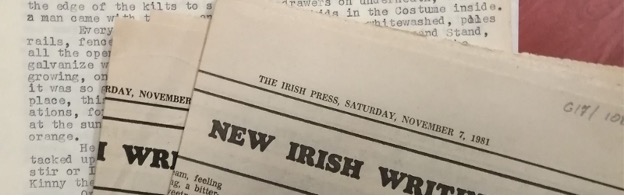
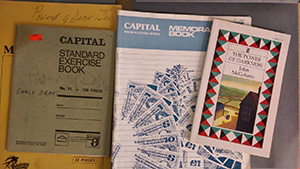
| A selection of the McGahern archives, from the University of Galway archives. |
University of Galway Library is home to archives of some of Ireland’s most celebrated writers, in both English and Irish language. Across novels, stories, poems, and non-fiction, these manuscripts show the development of Irish writing through initial drafts and edits to their final published form and in a range of media, from writing for the page to the screen.
John McGahern (1934 – 2006) is recognised as being one of the preeminent Irish writers of the twentieth century. Born in Co. Leitrim, McGahern is associated with the west of Ireland and a rural setting, with a pastoral essence to his writing across the novel and short-story form. McGahern’s first published novel, The Barracks (1963) tells of the story of Elizabeth Reegan and her coping with illness as well as a brutish husband, a sergeant in a quiet western parish. The Dark (1965) was famously banned in Ireland on grounds of indecency and saw McGahern forced to leave his job as a primary school teacher. Early short story collections include Nightlines (1978), High Ground (1985).
A change of literary style is seen in McGahern’s 1979 novel, The Pornographer with his later works, such as Amongst Women (1990) often cited as among a most beloved book by his readers, with McGahern’s final novel, That They May Face The Rising Sun (2000) regarding as his masterpiece. The McGahern archive comprises over seventy boxes of manuscripts of multiple drafts and revisions of all McGahern’s writings in fiction and non-fiction, including hand-written drafts of Memoir (2005). The archive includes over 1,500 letters sent to McGahern from his literary contemporaries, publishers, friends, and family from the 1950s to the time of his death in 2006, as well as other materials, including photographs and personal affects.
 |
|---|
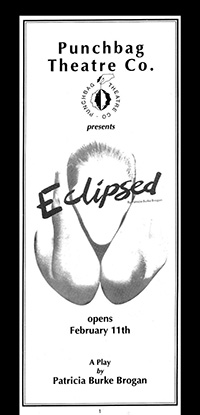
| An image of the title page of Eclipsed by Patricia Burke-Brogan, from the University of Galway archives. |
Patricia Burke-Brogan (1932 – 2022) was a playwright, poet, and artist. Born in Co. Clare, Burke-Brogan lived most of her life in Galway. Her most famous play is Eclipsed (1992). First performed in Galway by Punchbag Theatre Company, it tells the story of a young woman who is . Burke-Brogan spent time as a novice at the Sisters of Mercy in Galway where she saw first-hand the treatment of women within Galway Magdalene Laundry on Forster Street. The play has been translated into many languages and performed around the world. Poetry collections for which Burke-Brogan is well known for include Above the Waves/Calligraphy (1994) and also her 2009 Memoir With Grykes and Turloughs.
The Burke-Brogan Archive contains manuscripts and draft editions of her writing in poetry and for theatre, including scripts of a later play entitled Stained Glass at Samhain. The archive includes correspondence with other writers, academics, and artists interested in her work and about staging her work. Original playbills and photographs from the first production of Eclipsed and subsequent productions also feature. Burke-Brogan was posthumously awarded the Freedom of Galway City in 2022.
Eoghan Ó’Tuairisc / Eugene Watters (1919 – 198)2. was a bilingual writer of poems, stories, novels, plays, and criticism primarily associated with writing in the Irish language.
From Ballinasloe in Co. Galway, Ó’Tuairisc published his first novel, Murder in Three Moves, in 1960. Set in the west of Ireland the detective story follows a storyline based on a chess theme. Further works came in 1962, L'attaque, depicts and is set during the French invasion of Ireland in 1798, with the protagonist Máirtín. Another well-known work, in Irish language is An Lomnochtán (1977), a modernist-style telling of an Irish childhood through a young boy in the midlands of Ireland. Manuscript drafts throughout O’Tuarisic’s archive offers a view of the craft and painstaking detail of his writing through the decades, in both the novel form and in poetry and across form and language.
 |
|---|
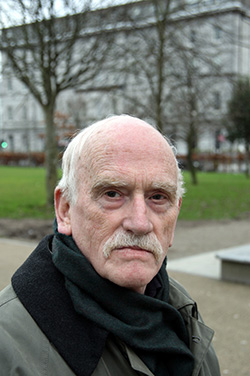
| A portrait of Thomas Kilroy, from the University of Galway archives. |
Thomas Kilroy (1934 – 2023) was Professor of English at University of Galway from 1978 until 1989 when he concentrated on his writing full-time. Born in Callan, Co. Kilkenny, Kilroy became one of Ireland’s most renowned playwrights, long associated with the Abbey Theatre, beginning with his first stage play at the Abbey Theatre on the Peacock stage, The O’Neill, in 1968. Kilroy’s novel, The Big Chapel, was shortlisted for the 1971 Booker Prize and recipient of the Guardian Fiction Prize also in 1971. Kilroy’s archive contains drafts and manuscripts of his writings for the stage as well as his novel and other writings of criticism on Irish literature. Also included are extensive correspondence files with other writers, including Brian Friel, Mary Lavin, John McGahern, among others.
Carolyn Swift (1923–2002) was a co-founder of Dublin’s Pike Theatre in 1953 with her husband, Alan Simpson. Swift was a producer, editor, and administrator of the Pike until it closed in 1961. Famed for produced works by Samuel Beckett and Brendan Behan, Swift’s archive includes her original annotated prompt script for the world premiere of Behan’s The Quare Fellow (1954) at the Pike Theatre. Swift later worked from the 1960s to the 1980s as part of RTÉ Drama and Light Entertainment departments, where she was a script editor and writer. Swift wrote and edited numerous series and plays for screen and radio. Swift adapted Maura Laverty’s Tolka Row for radio and also wrote for children’s television including episodes for Wanderley Wagon, Bosco, and Forty Coats, scripts of all which are within Swift’s archive.
Later in the 1980s Swift began writing a hugely popular series of children’s book series, including the Bugsy and Robbers series of books, as well children’s books of myths and folktales. Swift was also a board member of the Abbey Theatre, the Irish Film Board, The Society of Irish Playwrights, the Irish Writer’s Centre, among other groups. Swift’s archive contains over fifty boxes of manuscripts of Swift’s writings for stage, screen, radio, as well as her extensive publications for children, as well as records of her advocacy and activism.
Tim Robinson (1935 - 2020) is a pioneering writer of landscape, a cartographer and artist. Born in England, Robinson studied Mathematics at Cambridge University, before settling in the West of Ireland in the 1970s. In a career of over forty years, along with his wife, Máiréad, Robinson documented the landscape and people of Connemara, the Burren, and the Aran Islands, through his research, maps, and publications.
Robinson published his first map of the Aran Islands in 1975, with his map of Co. Clare’s unique Burren region following in 1977. Robinson’s published a two-volume book study of the Aran Islands, Stones of Aran: Pilgrimage (1986) and Stones of Aran: Labyrinth (1995).
Robinson’s later Connemara trilogy of books, Listening to the Wind (2006), The Last Pool of Darkness (2008), and A Little Gaelic Kingdom (2011) are considered a highlight of his literary output.
Library
The Library proactively supports and enhances the learning, teaching, and research activities of the University. The Library acts as a catalyst for your success as University of Galway’s hub for scholarly information discovery, sharing, and publication.
Contact
Library,
University of Galway,
University Road,
Galway, Ireland
T. +353 91 493399
Find Us




© 2025 University of Galway. All Rights Reserved.
University of Galway is a registered charity. RCN 20002107