- My Library Account
- Collections
Collections
The Library provides access to books, electronic resources, archives, special collections, and more to support your learning and research.
- Research

Research
The Library is committed to supporting your research needs with expert guidance and resources.
- Studying
Studying
The Library has all the resources and supports you need to be successful in your studies at undergraduate and postgraduate level. Whether you're just starting your studies or working on your final project, we're here to help.
- Teaching

Teaching
We are here to help lecturers and academic staff deliver quality teaching and support their students' success.
- About
- Workshops & Events
Irish Culture
.jpg)
Irish Culture
The Library at University of Galway is home to a rich and growing suite of Heritage Collections, including those related to music and song, folklife and lore, sport and Irish culture in general.
 |
|---|
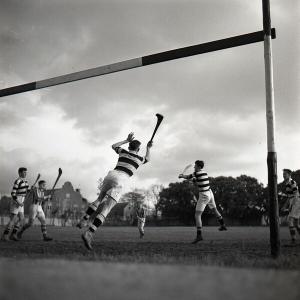
| Photograph of schoolboy hurlers protecting their goal, 1952, from Ritchie-Pickow Archive. |
Music and Song
Noteworthy Irish traditional music collections include the archives of esteemed Irish button accordion player Joe Burke, of Kilnadeema, East County Galway, co-founder of the Leitrim Céilí Band. This collection includes correspondence with fellow musicians, friends and fans alongside photographs of Joe with other musicians and of places he visited, giving a unique insight into his life as a touring professional traditional Irish musician while performing in America, the UK, Japan and Ireland.
From Carna in the west of the county, another Joe prominent in the Irish Traditional Music sphere was Joe Heaney (Seosamh Ó hÉanaí), one of the twentieth century’s greatest exponents of the sean-nós singing tradition. To this day, his name is known and respected nationally and internationally, and his archive contains several hundred examples of his singing, storytelling and knowledge of folklore in Irish and in English, in the form of audio recordings, along with copious annotations.
Audio recordings feature also in the archive of wildlife filmmaker, musician, author and Senator Éamon de Buitléar, a founding member of Seán Ó Riada's folk-orchestra Ceoltóirí Chualann (1960–1969) and founder of Ceoltóirí Laighean in the early 1970s following Ó Riada’s death in 1971, both groups of which were precursors for The Chieftains. The Éamon de Buitléar Collection also offers a unique insight into filmmaking in Ireland, in both English and Irish, and includes a dictionary of bird names in Irish put together by Éamon and his father.
Classical music is also represented across the archives, including in the archive of Music for Galway, formed in 1981 with the goal of bringing local, national and international renowned classical music to the people of Galway. Since their formation, Music for Galway have established their place as a leading cultural group in Galway and Ireland and have hosted renowned Irish and international acts such as the Hallé Orchestra, RTÉ Philharmonic Orchestra, Robert Taub, Philip Cassard, RTÉ Vanbrugh String Quartet, Sharon Shannon, RTÉ Concert Orchestra, John O'Conor, the Feis Ceoil finalists and winners, Regina Nathan, Patricia Bardon and Contempo Quartet among others.
Folklife and lore, The University is also custodian of the Rev Daniel J. Murphy archive. Rev Murphy (1858-1935) of Sligo and J.J. Lyons of Galway set about transcribing folklore and songs from their fellow countrymen and women who had migrated to the coal mining districts all around Philadelphia and Pennsylvania. Together, they transcribed around 1,200 sean-nós songs, many of which did not survive the decline of the language in Ireland. A song collection of such magnitude and high-quality puts this largely unknown opus on a par with the work of Ireland’s best-known and most prodigious music collectors including Edward Bunting, George Petrie, Sam Henry, and Séamus Ennis. However, the achievement of Murphy and Lyons is even more extraordinary for having emerged from an atypical context: an industrialized urban cosmopolitan centre on the East Coast of America. In scale and context, it echoes the celebrated work of their contemporary and fellow countryman Chief Francis O’Neill (1848-1936), who collected c.1,850 tunes in Chicago.
Prof. Tomás Ó Máille’s archive of 398 recently digitised wax cylinders showcases vocal content in Irish, including speech, storytelling, and song, reflecting his lifelong interests in linguistics, folklore, and music collecting.
 |
|---|
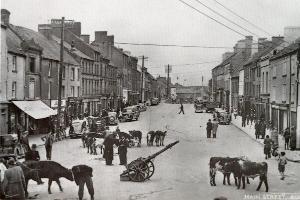
| Black and white postcard entitled Main Street, Roscrea, 1955, from Dr. Heinrich Becker Collection |
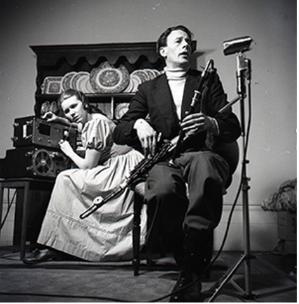
The Ritchie-Pickow Collection provides a captivating photographic record of the practice of music, song, and folklore collecting as well as the recordings themselves. It consists of recordings by collector Jean Ritchie and photographs taken by her husband, photographer George Pickow, over an 18-month period while on visits to Ireland in 1952 and 1953. The photographs include images of many well-known uilleann pipe players, such as Seamus Ennis, Michael Reagh, the McPeake trio and Leo Rowsome as well as vocalists including Elizabeth Croinin, Sarah Makem and Mary Toner and story tellers, such as Patcheen Faherty from the Aran Islands. Material also features aspects of Irish cultural life including Christmas celebrations with straw boys and wren boys, life on the Aran Islands, and Irish sporting activities, such as road bowling, hurling, coursing, hunting and racing. Photographs were also taken of traditional Irish crafts, for example spinning, weaving, thatching and crios and sliotar making. This Ritchie-Pickow digital collection can be viewed on our Digital Collections Repository.
In 1939 a young German folklorist, Heinrich Becker, came to Galway to research stories associated with the sea. Beginning first with the fishermen of the Claddagh and later moving out to the shores of Galway Bay and the Aran Islands, he created a wealth of audiotapes, photographs, transcripts of stories and associated material, and took a keen interest in what was happening around him. The Heinrich Becker Collection offers a unique insight into the folklore of the Galway Bay area.
 |
|---|
|
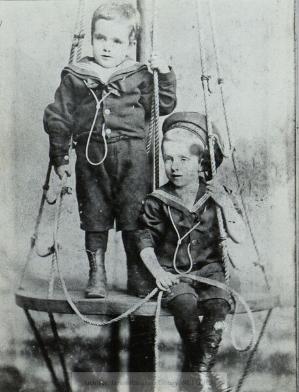
Black-and-white photograph of Michael Dominic and John Aloysius Cusack, from Michael Cusack archive, 1880 |
Irish Language
Throughout its existence, staff of Conradh na Gaeilge have been actively involved in promoting and observing the use of Irish across all aspects of everyday activities, and as such The Conradh na Gaeilge archive, the second largest at the University of Galway, is an immensely rich and important resource. It includes material relating to music, drama, literature and sport, including what is believed to be a photograph of the first ever Camogie team from the Navan branch, taken in 1904. Programmes for the annual Oireachtas competitions, going back to the inaugural year in 1897 have all been recently digitised and are available open access online.
Irish Sport The Michael Cusack collection is the unique personal collection of the founder of the GAA, generally acknowledged to be the greatest amateur sporting organisation in the world. The GAA, which remains a dominant force in Ireland's cultural and sporting life, was founded in 1884 as a highly influential element of the Irish cultural renaissance of the late nineteenth century and of Ireland's struggle to re-establish its own political, linguistic and cultural identity. Among the most important historical items in the collection are the complete minutes of the Dublin Hurling Club, from 1883. Cusack was Vice-President of the club, a predecessor to the national organisation founded the following year.
Special Collections
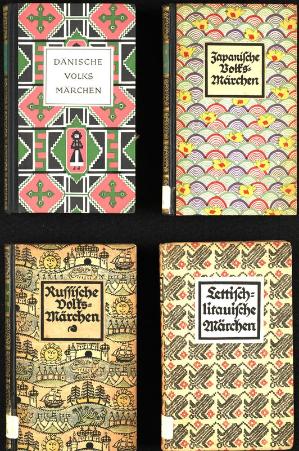
Alongside our wealth of archival collections, our special collections also contain some real gems. A fine representation of writings on all aspects of both Irish and European folklore for much of the 20th century can be found in the Delargy Collection. This very large collection originally constituted part of the library of Séamus Ó Duilearga (1899-1980), former Professor of Irish Folklore at University College Dublin. In addition to the book material, there is a significant collection of offprints received by Professor Ó Duilearga from academic colleagues throughout the world.
 |
|---|
|
Volumes of folktales from around the world from the German series Märchen der Weltliteratur original owned by Seamus Ó Duilearga. |
The extensive Ó Curraoín collection, donated by the family of the late Micheál Ó Curraoín, who assembled the collection during many years of travel and scholarship, is particularly strong in Irish Local Studies publications, of which he was a diligent collector. The library of the late Ronnie O’Gorman was accessioned in June 2024 and comprises 1912 volumes. This remarkable collection includes many unique items, including a 1st edition of James Joyce’s Ulysses as well as some very fine binding editions of Galway-associated material. It also includes upwards of 50 titles relating to Irish folklore.
The main Special Collections library contains significant holdings on sport in Ireland with special reference to Gaelic Football and hurling. This is complemented by the student periodical collection, which covers the period from the early 20th century onwards and provides insight into the development of various sports within the University.
Important standard works relating to music in Ireland such as Joseph C. Walker's Historical Memoirs of the Irish Bards ((1786), Edward Bunting's The Ancient Music of Ireland (1840), George Petrie and Charles V. Stanford's Complete Music of Ireland (1902-1905) and Francis O'Neill's Music of Ireland (1903) can also be found in our holdings. Music is also represented in some of our Named Book Collections. The Arthur Shields book collection, for example, includes several song books, including a collection of Irish comic songs published in 1948. A variety of musical genres is represented in the Dominican Convent library including classical and Irish as well as sacred music and musical theory, primarily from the first half of the twentieth century.
In 2016 the Dominican sisters at the convent of Jesus and Mary, Taylor’s Hill, Galway, donated a substantial library of over 2000 volumes to the University. The material ranges from early 17th century religious works such as a life of St. Teresa of Avila dating from 1611 to volumes used in teaching at the Taylor’s Hill boarding school in the later 19th and early 20th centuries.
 |
|---|
| Photograph of Jean Ritchie recording Seamus Ennis playing the uilleann pipes, 1952, from Ritchie-Pickow Archive. |
Library
The Library proactively supports and enhances the learning, teaching, and research activities of the University. The Library acts as a catalyst for your success as University of Galway’s hub for scholarly information discovery, sharing, and publication.

Contact
Library,
University of Galway,
University Road,
Galway, Ireland
T. +353 91 493399
Find Us




© 2025 University of Galway. All Rights Reserved.
University of Galway is a registered charity. RCN 20002107