- My Library Account
- Collections
Collections
The Library provides access to books, electronic resources, archives, special collections, and more to support your learning and research.
- Research

Research
The Library is committed to supporting your research needs with expert guidance and resources.
- Studying
Studying
The Library has all the resources and supports you need to be successful in your studies at undergraduate and postgraduate level. Whether you're just starting your studies or working on your final project, we're here to help.
- Teaching

Teaching
We are here to help lecturers and academic staff deliver quality teaching and support their students' success.
- About
- Workshops & Events
Galway City & County
Galway City & County
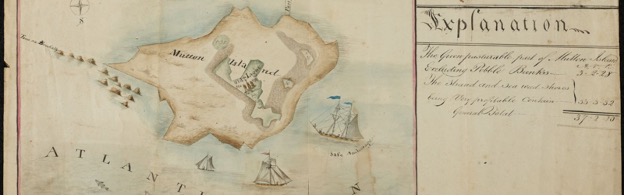
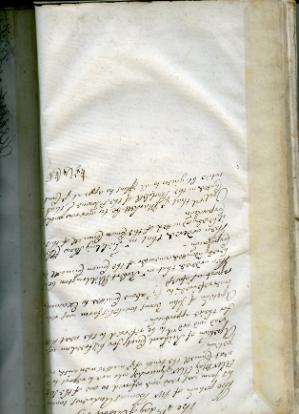
From the establishment of the University Library in 1849 with it’s first librarian James Hardiman, we have collected material relating to the history of Galway. Indeed Hardiman himself, a noted historian of Galway, donated the records of Galway Corporation dating from 1485 to 1818 to the Library. Across our archival holdings there are collections which reflect the rich and diverse heritage of the town and county of Galway.
 |
|---|
|
LA1_D_004 Page from the minute book of Galway Corporation detailing the admission of freemen and regulations for running the town market, 4th October 1691 [LA1/4 Galway Corporation Records: Liber D: p.4]. |
Little is known about the early development of Galway as a town, although it clearly begun to develop sometime in the later thirteenth century. It is thought that Walter, son of Richard de Burgo granted the town burgage status as work had begun on the town walls by 1272. (P Walsh, 'The Topography of Medieval and Early Modern Galway City', in G Moran (ed), Galway: History and Society, 52; H G Richardson's review of M D O'Sullivan's work in IHS 4 (1944-5), 362; Hardiman's History, 49-50; Thomas. Walled Towns of Ireland). In 1361 the town received a grant for five years 'in aid of enclosing the said town'.
In November 1395 Richard II granted a new murage charter to the town of Galway 'to be enclosed with a stone wall, as of the parts adjacent, and in aid of paving the said town'. As with most towns in late medieval Ireland, the walls of Galway served to protect against raids, as well as providing a physical reminder of the free status of the citizens of the town from neighbouring lords. While the town may have struggled somewhat in the fourteenth century, there is no doubt that the town begun to expand rapidly in the fifteenth century. It achieved administrative autonomy with the grant of a royal charter in 1484. "The granting of a charter in 1484, allowing the burgesses power to elect yearly a mayor and two bailiffs gave them, in effect, autonomous control over their affairs, and, in the following year, with the establishment of St. Nicholas as a collegiate church subject to the local corporation, the town may be said to have achieved both administrative and ecclesiastical independence" (P Walsh, 'The Topography of Medieval and Early Modern Galway City', 56).
Earlier grants than the 1484 charter paved the way for the merchants of Galway to gain independence from their Clanrichard neighbours. In 1396, along with the earlier grants of murage and pavage, they achieved independence in their administrative and judicial dealings by acquiring the same rights as Drogheda from Richard II for £6.13.4.
 |
|---|
|
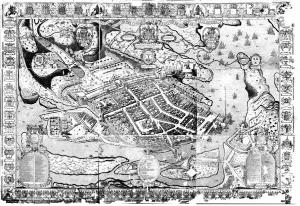
p133_0005_0002_0001_0037 Mid-seventeenth-century map of Galway City 1650 |
A clause within this grant allowed the Burkes to maintain control of the city, a right attempted by the Clanricard Burkes throughout the fifteenth century. This was taken away in 1464 and in 1484 the royal charter was the capstone of over a century of attempted administrative and judicial independence on the part of the townspeople (G Mac Niocaill, 'Medieval Galway: Its Origins and Charter', in D O Cearbaill (ed), Galway: Town and Gown 1484-1984, (Dublin, 1984), 1-9). The records of Galway Corporation from its foundation in 1485 to 1818. It consists of a statute book (Liber A) giving the names of members of the Corporation and statutes passed (1485 to 1710). Also the minute books of meetings of the Corporation from 1679, giving the dates of meetings, attendance, and business transacted. Also some loose legal material relating to a court case before the House of Lords dealing with the election of Valentine Blake as MP for Galway in 1814.
From 1836 to 1898 the functions of the corporation were taken over by Galway Town Commissioners. The Galway Town Commissioners were established the under provisions The 1828 Act for the Improvement of Lighting in Towns. The Board of the Galway town Commissioners itself was established by the Galway Improvements Bill which was passed in Parliament in 1836. The Board took over all the local authority functions of Galway Corporation following the Corporation's abolition in 1840. The establishment of the Town Commissioners and the abolition of Galway Corporation represented the relegation in administrative terms of Galway to the status of a town. While arguably the 19th century was a period in which Galway was in relative decline it was also a period during which the city was 'modernized'. During the period in which The Board of the Galway Town Commissioners was in operation street lighting, running water, trams and later electricity and telephones were introduced to Galway.
 |
|---|
|
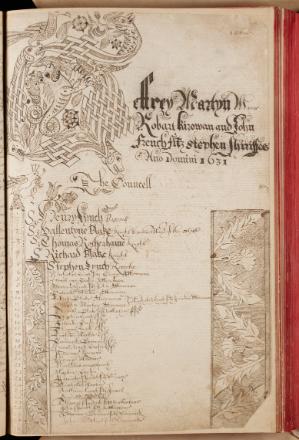
LiberA_0001 List of the mayor, bailiffs, aldermen and members of Galway Corporation, 1st August 1631 {LA1/1 Galway Corporation Records: Liber A, p. 196]. |
It was also the period during which a rail-link with the rest of the country was established, the Corrib navigation was built, The University was established and the race course at Ballybritt was laid out. The minutes contained in the bound volumes that comprise this collection reflect in large measure these improvements. The Board of the Galway Town Commissioners was directly involved in the construction and maintenance of some of these improvements, such as the water supply while it was also heavily involved in lobbying for other projects such as the railway and canal. There were a number of unsuccessful attempts to establish Galway as 'A Packet Station' for transatlantic shipping, the hope was that Galway could become 'A Liverpool for Ireland', this hope was partially based on the idea that a passengers and goods would reach London more quickly if they disembarked at Galway than traveled by rail to Dublin, caught a ferry to Wales and then traveled on to London by rail.
Galway Urban District Council was set-up after the 1898 Local Government Act, it replaced the Board of the Galway Town Commissioners. As an 'Urban District Council' rather than a 'Corporation' the body was subordinate to Galway County Council, in administrative terms this put Galway City on the same level as towns such as Athlone and Clonmel. Galway Urban District council was responsible for the upkeep of Galways roads, street lighting and the collection of tolls. Unlike it predecessor body the Galway Town Commissioners it was also responsible for the provision of 'social housing'. During the period covered by this collection a number of housing schemes in Galway city were undertaken by the Urban District Council, including the construction of 'working class' homes in Henry Street. The period covered by this collection also saw the replacement of the tram service to Salthill with a bus service. The minute books of the Galway Urban District Council also include a number of references to political events of the time including The First World War, The Conscription Crisis and the War of Independence. A resolution passed on 17 June 1920 explicitly stated that the Urban District Council recognised "the authority of Dail Eireann as the duly elected Government of the Irish people".
 |
|---|
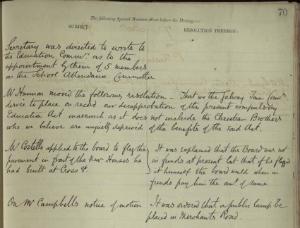
| LA2_0004_0070 Extract from the Proceedings of Galway Town Commissioners, dated 7th December 1893 [LA2/4 Galway Town Commissioners Records: book 4, p. 70. |
Other Collections record the importance of Galway as a transport hub for the town. Microfilm records of the Galway Harbour Commissioners highlight the role of the port in the economy of the town, as well as the passenger traffic coming through the port from the mid-nineteenth century onwards. Collections relating to the Lough Corrib Steam Boat Company Ltd. and also the Galway to Clifden Light Railway Company highlight the development of transport in the county at this time.
Landed Estates
Landed estate collections from the county highlight a range of estate management and other activities, and the impact of the land acts on the county at the beginning of the twentieth century. Rent rolls highlight the economic situation in the county from the seventeenth century onwards, legal papers show how the estates were passed through the generations, while estate management papers highlight a range of activities on each estate. Finally, the politics, culture, religion and hobbies of landed estate families are well represented in these papers.
From our political holdings there are a number of collections which reflect the Galway played during the revolutionary period, as well as collections relating to politics in the town and county of Galway. These include papers relating to the possible landing of arms at Leenane/Letterfrack, papers relating to the murder of Harry and Patrick Loughnane of Shanaglish near Gort by Crown forces, and the Papers of Brian Cusack TD. Other collections, relating to the 39th Regiment of Foot and the Connacht Rangers amongst others, reflect the service of Galway men in the British Army. Cultural activity in Galway city and county is evident across the personal papers section of the archives, covering the Irish language revival, sporting and cultural activities, including theatre, horse-racing and photography amongst other subjects. We hold collections relating to An Taibhdhearc, Druid Theatre Company, the Galway Arts Fesitval and Cuirt, as well as theatre people in the town such as Liam O Conchubhair, Siobhan McKenna, Christopher Townley, Frank Bailey and Sean Stafford.
The archive of Tim and Máiread Robinson documents all aspects of their work in the Galway Bay area, once referred to by Tim as “the ABC of earth wonders”, referring to Aran, the Burren and Connemara. It includes manuscript material comprised of drafts and first editions, sketches of maps, photographs, correspondence in which detailed nuances of placename spellings, plant specimens, ecological history are poured over, all of which are woven into his maps and his writing work.
Tim Robinson’s townlands index has been digitised, this is made up of information distilled from the greater archive, and provides a visual and approachable entry point into a dense web of themes and material. It can be consulted from digital.library.universityofgalway.ie.
Library
The Library proactively supports and enhances the learning, teaching, and research activities of the University. The Library acts as a catalyst for your success as University of Galway’s hub for scholarly information discovery, sharing, and publication.

Contact
Library,
University of Galway,
University Road,
Galway, Ireland
T. +353 91 493399
Find Us




© 2025 University of Galway. All Rights Reserved.
University of Galway is a registered charity. RCN 20002107