- My Library Account
- Collections
Collections
The Library provides access to books, electronic resources, archives, special collections, and more to support your learning and research.
- Research

Research
The Library is committed to supporting your research needs with expert guidance and resources.
- Studying
Studying
The Library has all the resources and supports you need to be successful in your studies at undergraduate and postgraduate level. Whether you're just starting your studies or working on your final project, we're here to help.
- Teaching

Teaching
We are here to help lecturers and academic staff deliver quality teaching and support their students' success.
- About
- Workshops & Events
Engineering
Engineering
In October 1849, Queen’s College Galway began educating students in the faculties of Arts, Medicine and Law. Schools of Agriculture and Engineering formed part of the Faculty of Arts, which resided within the halls of the new University’s gothic limestone quadrangle. The fully enclosed quad is John Benjamin Keane’s design, selected by the Board of Trade as “a magnificent edifice in the style of Henry the Eight[h]’s time”[i]. It is very different in style to its Queen’s College counterparts in Belfast and Cork.
Professor Edward Townsend became head of the school of Civil Engineering in 1860 and combined his role as an educator with that of a railway engineer. He and John Henry Ryan designed the Galway-Clifden railway, with the Corrib Viaduct providing an excellent locally available training model for the students who were sent out to “work out the design in reverse – that is, to start with the finished product and ‘progress’ backwards through the various design stages.”[ii]
During his career as an educator, Professor Townsend taught two University of Galway alumni of note - Michael Maurice O’Shaughnessy from 1881-1884, and Alice Perry from 1902-1906.
Michael Maurice O’Shaughnessy
A substantial archive of the former is held at University of Galway, documenting an illustrious civil engineering career in America, where he emigrated to in 1885. Initially making his way with real estate, mining and railway projects in California, O’Shaughnessy then worked on water irrigation projects connected with sugar plantations in the Hawaiian Islands.
 |
|---|
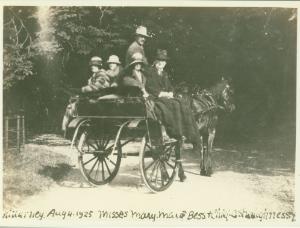
| O'Shaughnessy and family, an image from the University of Galway archives. |
Following the devastating earthquake and fire in San Francisco in 1906 where his family were, he took on projects closer to home in San Diego, and in 1912 he was appointed San Francisco’s city engineer, a position he held for 20 years which combined his engineering skills with astute political perception.
Michael M. O’Shaughnessy holds an impressive and ubiquitous legacy in San Francisco to this day. He oversaw reconstruction of San Francisco following the devastation at the beginning of the century, and was responsible for constructing its municipal railway system, he upgraded the city’s water and sewer systems, and carried out feasibility work on the San Francisco Bay Bridges (Dumbarton, Golden Gate, and San Francisco-Oakland Bay Bridges).
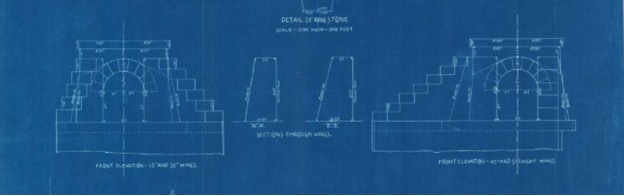
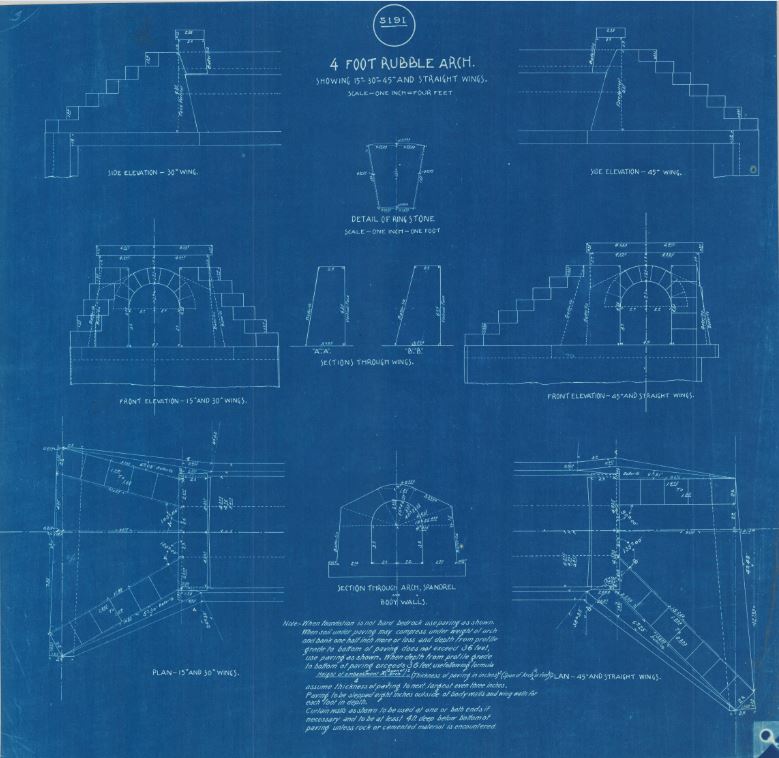
He is perhaps best remembered for the Hetch-Hetchy project, a controversial dam and aqueduct design that carried water over 269 km from the Sierra Nevada to San Francisco. It continues to provide most of San Francisco’s water needs to this day, though a battle continues between those who wish to retain the dam and reservoir, and those who wish to return the valley to its former state. This archive includes substantial correspondence, blueprints and plans, and other working documents from O’Shaughnessy’s early career. There are also first-person accounts of his work in Hawaii, and hundreds of photographs illustrating his career and his family life.
 |
|---|
| Hawaii rubble arch blueprint, from the University of Galway archives |
The archive has been digitised in its entirety.
A permanent exhibition is on display on the first floor of the Alice Perry Engineering Building, and tells the story of O'Shaughnessy's career, using extracts from his unpublished memoir, Engineering Experiences: From Honolulu to Hetch Hetchy to add his distinctive voice to its narrative.
The exhibition also tells of his influence in the Shannon and Poulaphuca Schemes in Ireland. Also on display are a brass circumferentor (surveyors' compass) marked Adie Edinburgh, and a clinometer made by T Bennett Cork.
 |
|---|
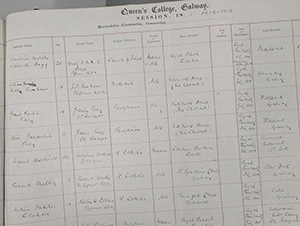
| An image of Alice Perry's matriculation record, from the University of Galway archives. |
Alice Perry
Alice Perry, believed to be the first female engineering graduate in the world to receive a first-class honours degree in civil engineering in 1906 also studied under Professor Townsend. She had the distinction of also being Ireland’s only female County Surveyor, temporarily replacing her father for Galway West following his retirement, before travelling to London and pursuing a career in Industrial Safety until she retired in 1922. (Duffy, p. 139).
Alexander Nimmo
There are also examples of primary source engineering documents in the University’s heritage collections that predate the foundation of the University. In the archive of Tim Robinson, he examines the work of Alexander Nimmo, who designed the village of Roundstone, which was founded in 1824. Copies of Nimmo’s work for the Commission of Irish Fisheries are supplemented with notes and correspondence, as part of Robinson’s research for his esteemed Connemara maps and book trilogy. There are also several references to Nimmo’s 1823 map in the townlands index, which has been digitised and can be found here: Townland Index
Galway’s Picture Palace / Pálás
In a more modern engineering context, in the archive of Lelia Doolan is material relating to the development and planning of Galway’s Picture Palace / Pálás Cinema. Site surveys and vision statements during the city’s lengthy process to construct its beloved arthouse cinema can be found.
[i] Dictionary of Irish Architects 1720-1940, Entry for John Benjamin Keane, University College, University Road, Galway https://www.dia.ie/works/view/9224/building/CO.+GALWAY%2C+GALWAY%2C+UNIVERSITY+ROAD%2C+UNIVERSITY+COLLEGE Accessed 12/02/2025
[ii] Paul Duffy ‘Engineering’, in From Queen’s College to National University. Essays on the Academic History of QCG / UCG / NUI Galway, ed. Tadhg Foley, (Dublin, 1999), p. 130
Library
The Library proactively supports and enhances the learning, teaching, and research activities of the University. The Library acts as a catalyst for your success as University of Galway’s hub for scholarly information discovery, sharing, and publication.

Contact
Library,
University of Galway,
University Road,
Galway, Ireland
T. +353 91 493399
Find Us




© 2025 University of Galway. All Rights Reserved.
University of Galway is a registered charity. RCN 20002107