- My Library Account
- Collections
Collections
The Library provides access to books, electronic resources, archives, special collections, and more to support your learning and research.
- Research
Research
The Library is committed to supporting your research needs with expert guidance and resources.
- Studying
Studying
The Library has all the resources and supports you need to be successful in your studies at undergraduate and postgraduate level. Whether you're just starting your studies or working on your final project, we're here to help.
- Teaching
Teaching
We are here to help lecturers and academic staff deliver quality teaching and support their students' success.
- About
- Workshops & Events
Irish Language
Irish Language
 |
|---|
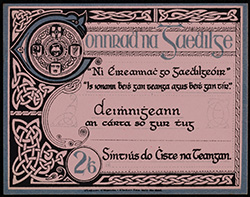
| Membership card from Conradh na Gaeilge |
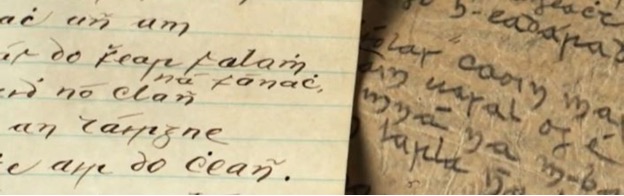
The study of language and culture offer insights into how a society and nation communicates its identity. In any field of the humanities, archives are the lifeblood of research, they offer insights into the day-to-day business of individuals and organisations, cover a range of formats, and provide material of evidential and informational value to the researcher. The archives service of University of Galway Library, now known as Heritage Collections and Digitisation, has a long tradition of acquiring, preserving and making accessible collections in and relating to the Irish language. In doing so it hopes to support the teaching and research needs of staff and students in the university, as well as strengthen links between the university and the community.
Athbheochan na Gaeilge [Revival of the Irish Language]
 |
|---|
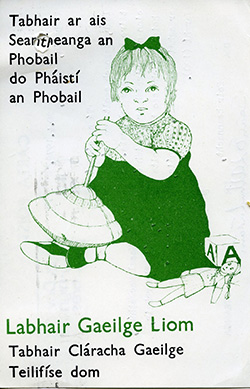
| “Labhair Gaeilge Liom”, postcard from campaign to increase Irish language programming on RTÉ, 1970s-1980s. |
The revival of the Irish language has been central to Irish identity since the late nineteenth century. A number of important collections from individuals and organisations relate to this goal. We were delighted to have become custodian of the Conradh na Gaeilge collection which was preserved, processed, catalogued and then launched in 2022. Covering every decade from Conradh’s first in the 1890s to the present, topics range from raising children through Irish to apartheid in South Africa, from organising feiseanna to campaigning for civil rights, from the work of the Timirí [branch organisers] nationwide to the minutiae of company finances. The extensive Conradh na Gaeilge collection is augmented by material related to several individuals who played key roles in the organisation. These include Douglas Hyde, Stiofán Bairéad and Tomás Ó Concheanainn. Later activists such as Pádraig Ó Mathúna based in Cashel have also left material with us.
Library Collections
Literary collections relating to literature in Irish stretch back to the seventeenth century, including Lámhscríbhinní Dhubhghlas de hÍde [Douglas Hyde manuscripts] and Lámhscríbhinní Breise [additional manuscripts], containing many prose and poetry extracts. There are also papers such as the Rev.Fr. Murphy Collection, containing versions of folk songs, prayers and poetry. The Heinrich Becker Collection offers a unique insight into the folklore of the Galway Bay area. More recent writers in Irish are represented by the Eoghan Ó Tuairisc Collection among others. Archival material from other writers includes Tadhg Seoighe, Pádraig Ó Domhnalláin,
Eoghan Ó Neachtain, Joe Steve Ó Neachtain, Seosamh Mac Grianna, Séamus Ó Grianna (‘Máire’), Fionn Mac Cumhaill, Brian Ó Baoill and others.
Special Collections
 |
|---|
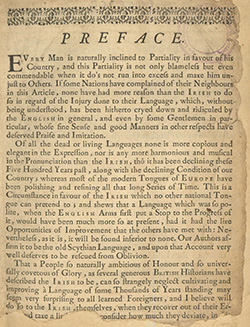
| Conchobar O Beaglaoich with assistance of Aodh Buidhe Mac Cuirtin. The English Irish Dictionary. An Focloir Beurla Ghoidheilge. Paris: Seamus Geurin, 1732 (preface) |
As befitting the library of an institution within which the Irish language has held a special place for many years, the Library’s Special Collections holds many books published in the language from the 17th to the 21st centuries. Among our highlights is a copy of the first English-Irish dictionary ever printed. It was published in Paris in 1732 by Jacques Guérin (1699? - 1752), and it is effusive in its presentation of this “so little known” language: “Of all the dead or living languages none is more copious and elegant in expression, nor is any more harmonious and musical in the pronunciation than the Irish”.
Íosagán was the first collection of short stories to be produced by Padraic Pearse (1879-1916). The Library’s copy bears his New Year’s wishes for 1908 in an inscription to his good friend Stiofán Bairéad (1867-1921), honorary treasurer to the Gaelic League and part-collaborator of our Bairéad book and archival collection.
Digital Collections
Along with providing physical access to archives, work is ongoing to provide virtual open access to a selection of archival material through uploading digital collections, and through a programme of digitisation of physical archives. Digital collections include the Conradh na Gaeilge Digital Collection at 60,000 images, representing 10% of this enormous collection; An Gaodhal, the first-ever Irish language newspaper, published in Brooklyn, New York between 1881 and 1899, digitised in partnership with New York University, and now part of a project seeking to train AI to read Seanchló; An Stoc, one of the first provincial newspapers in Irish and the first in Connacht, edited by Tomás Ó Máille and containing articles by many academics and others associated with University College Galway at the time (1917-1931).
The Heritage Collections and Digitisation section also works closely with Acadamh na hOllscolaíochta Gaeilge based in the three centres in the Gaeltacht – Carna, Gaoth Dobhair and An Cheathrú Rua, as well as in the main university campus in Galway city. Collections made available through this partnership include the Seán Mac Giollarnáth Collection, the Éamon de Buitléar Collection, the Joe Heaney Collection, the Raidió na Gaeltachta Archive, and many other collections that give insights into the heritage and culture of Irish.
Other Activities Through Irish
Other collections show how various activities were carried out in Irish. For example, the Seaghan P. Mac Énrí Collection, Eric Mac Fhinn Collection, Proinsias Mac an Bheatha Collection, Nollaig Ó Gadhra Collection and Proinsias Mac Aonghusa Collection are concerned with newspaper and broadcast media in Irish; the Seosamh Ó hÓgartaigh Collection shows business being conducted through Irish and the Taibhdhearc na Gaillimhe Collection is a full record of the Irish language national theatre, with many other cultural and sporting organisations supporting the use of the Irish language also represented. Both sides of the debate on the Irish language in the 1960s are represented by Conradh na Gaeilge, as well as the papers of the Language Freedom Movement. The Éamon de Buitléar Collection offers a unique insight into filmmaking in Ireland, in both English and Irish, as well as Irish music and a dictionary of bird names in Irish put together by Éamon and his father.
Library
The Library proactively supports and enhances the learning, teaching, and research activities of the University. The Library acts as a catalyst for your success as University of Galway’s hub for scholarly information discovery, sharing, and publication.
Contact
Library,
University of Galway,
University Road,
Galway, Ireland
T. +353 91 493399
Find Us




© 2025 University of Galway. All Rights Reserved.
University of Galway is a registered charity. RCN 20002107